The Code of Magic: Technology as Modern Sorcery

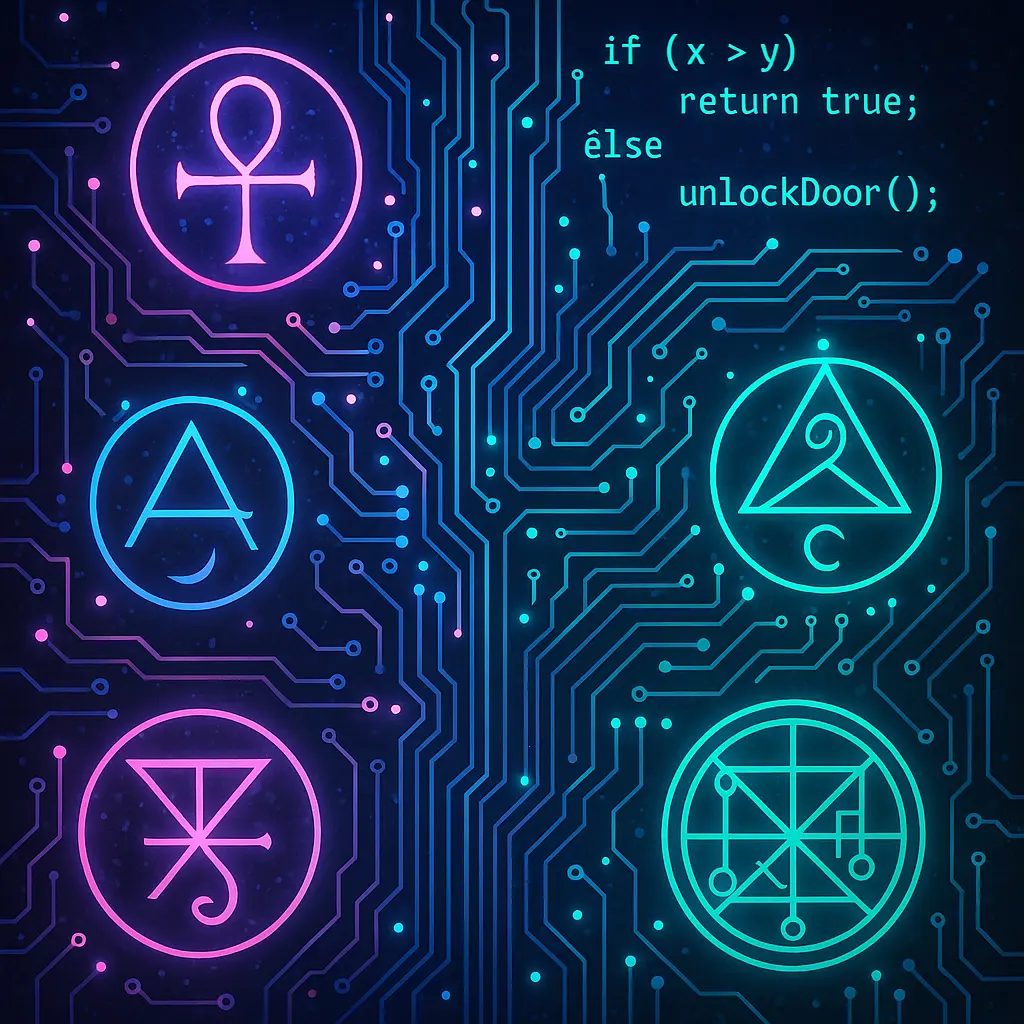
Introduction
In ancient times, the ability to write was nothing short of mystical. To an illiterate farmer, a scribe who could draw symbols on papyrus and convey the words of kings or gods might as well have been casting spells. Fast forward to today, and we find a similar aura around programmers and engineers. With a few keystrokes, a coder can summon information across the globe, unlock doors remotely, or send aerial drones whirring into the sky. It feels like magic – and in a poetic sense, it is magic. Modern technology, from code to circuitry, can be seen as a continuation of ancient magical practices, especially the age-old power of symbols and writing. In this speculative exploration, we’ll journey from the sacred scribes of old to the “wizards” of Silicon Valley, discovering how modern tech is essentially mythic sorcery reborn.
Writing as Sacred Knowledge
Since the dawn of civilization, writing has been viewed as a divine or arcane gift. In Egyptian mythology, Thoth – often called “Thoth the Atlantean” in later esoteric tradition – was revered as the god who invented writing and language (Thoth | God, Symbol, & Facts | Britannica). As the fable goes, Thoth bestowed writing upon humans, making literacy a sacred skill reserved for priests and scribes. In fact, Egyptian hieroglyphs themselves were called medu-netjer, “the words of the gods,” underscoring their mystical status. The act of writing – capturing spoken word into lasting symbols – felt supernatural to early humans, as if one could bottle thoughts and speak across time.
Across the world in ancient China, we find a parallel story. According to legend, the sage Cangjie invented the Chinese writing system and in doing so disturbed the order of heaven and earth. It’s said that on the night Cangjie created the first characters, the sky rained millet and ghosts wailed in the dark (Cangjie – Mythopedia). This fantastical tale hints at a profound truth: writing was perceived as an almost magical act that could influence cosmic and spiritual realms. The earliest Chinese writing (dating to the Shang dynasty) appears on oracle bones – turtle shells and ox bones used in divination rituals. Kings and shamans would inscribe questions and heat these bones, interpreting the cracks to divine the will of ancestors and gods. Thus, from the very beginning, writing in China was entwined with ritual and political authority, a tool to bridge the human and the divine (Chinese Calligraphy | Asia Society). Little wonder that those who mastered the brush were held in special esteem.
In many ancient societies, reading and writing were deliberately kept as privileges of an elite class. Sumerian and Egyptian scribes underwent years of difficult training to learn complex writing systems, and their literacy granted them significant power. In Egypt, for example, scribes were not only revered – they were exempt from taxes and hard labor, enjoying “valuable privileges, including exemption from military service... and even the payment of taxes” (Ancient Egypt: Scribes). Being a scribe was like being initiated into a secret society of knowledge. They recorded laws, economic transactions, and sacred texts, effectively controlling what was remembered or enacted in society. It’s telling that an Egyptian myth would credit Thoth (a god) with writing – literacy was a godlike power.
Chinese civilization similarly restricted literacy to an elite. For thousands of years, governance in imperial China was carried out by the scholar-officials, educated men who had mastered classical writing and Confucian texts. This was incredibly exclusive knowledge – “only a tiny fraction of the population of China was fully literate, and government officials were selected from this small group of highly educated scholars.” (Asia for Educators | Columbia University) In other words, writing was a gatekeeper to wealth and influence. A poor villager could rise to high office only by excelling in the literary examinations, effectively proving he had mastered the sacred lore of characters. Calligraphy itself was more than utilitarian writing; it was considered the highest form of art and a reflection of one’s inner virtue. With carefully crafted ink strokes, calligraphers were said to channel qi (spiritual energy) and capture the essence of a text. Small wonder that emperors and courts treasured calligraphers – their art straddled the line between communication and conjuration.
Sigils and Glyphs: Magic in Written Symbols
(File:72 Goeta sigils.png - Wikimedia Commons) Ancient magical sigils from occult grimoires. Practitioners believed these symbols, when inscribed with intent, could summon spirits or bend reality to the magician’s will. (Sigil - Wikipedia) (Sigil - Wikipedia)

Beyond everyday language, many cultures developed esoteric scripts and symbols meant explicitly for magic. In medieval European grimoires (magic textbooks), one finds pages of sigils – strange glyphs that served as the “signature” of angels, demons, or cosmic forces. In Latin, sigillum means “seal,” and indeed these were thought to seal a pact or command with a spiritual entity (Sigil - Wikipedia). To the uninitiated, a sigil looked like random squiggles; but to a sorcerer, it was a phone number for a spirit. Drawing the correct sigil as instructed could summon the associated angel or demon, compelling them to appear and obey. The infamous Lesser Key of Solomon, a 17th-century grimoire, lists 72 demons of Hell along with each of their sigils – a symbolic directory for a master conjurer (Sigil - Wikipedia).
The practice of inscribing symbols to alter reality wasn’t unique to Europe. In the Norse tradition, runes (letters of the runic alphabet) doubled as magical signs: a rune carved on a weapon might imbue victory, or one placed on a door could ward off evil. Medieval alchemists used cryptic astrological and elemental glyphs in their recipes, believing that these symbols carried the essence of the materials they represented. And in Chinese Taoist magic, practitioners drew talismanic seals (符) in special calligraphy – essentially stylized written charms – to invoke deities or repel ghosts. In all these cases, the act of writing is itself an act of magic. The written shape isn’t merely communicating an idea; it is the magic, a physical symbol charged with intention.
Why did people believe these squiggly lines could affect the world? Part of it lies in the power of intention and belief. A sigil is often created by taking a statement of intent (“bring me fortune”) and compressing it into an abstract design, a sort of mental shortcut to focus one’s will. The chaos magicians of the 20th century, like artist Austin Osman Spare, revived this idea – they would generate a personal sigil from a desire and then “charge” it with meditation or ritual, trusting the subconscious to do the rest (Sigil - Wikipedia) (Sigil - Wikipedia). In Spare’s words, one must then forget the sigil entirely so that the conscious mind lets the magic happen. This modern approach echoes ancient practices: whether it was an Egyptian carving a protective name on a tomb or a medieval witch writing abracadabra on a parchment (a charm to cure fevers, traditionally written in a diminishing triangle), the core idea is the same. Words and symbols have power – not just to communicate, but to alter reality when used with mastery.