How Frequency Jamming Works: Understanding Deliberate Signal Interference

Introduction
Wireless communications – from Wi-Fi networks and Bluetooth gadgets to GPS navigation – all rely on radio frequencies to send and receive information. Frequency jamming refers to the deliberate interference with these radio signals by flooding the airwaves with noise or false signals to disrupt communication (Jamming | Radio Frequency, Signal Interference & Jamming | Britannica) (An Introduction to Jammers and Jamming Techniques - JEM Engineering). In essence, a jammer broadcasts a strong signal on the same frequency as the target, overriding or obscuring the intended signal (Jamming | Radio Frequency, Signal Interference & Jamming | Britannica). This tactic has wide-ranging implications: criminals have used jammers to disable security systems, hobbyists experiment with jamming as a prank (illegally), and militaries employ jamming on the battlefield to confuse enemies. It’s important to distinguish jamming from ordinary radio interference – interference can occur unintentionally (like two stations overlapping), whereas jamming is intentional disruption (An Introduction to Jammers and Jamming Techniques - JEM Engineering). In the sections below, we’ll explore the technical fundamentals of jamming, the common frequency bands targeted (2.4 GHz, 1.6 GHz, etc.), how jamming affects civilian technologies (Wi-Fi, Bluetooth, GPS), its use against drones, and its role in military applications. We’ll also look at real-world examples of jamming in action and the mechanisms (barrage, spot, deceptive jamming) that make it possible.
Fundamentals of Radio Jamming vs. Interference
All radio devices tune to specific frequency bands to communicate. When another signal on the same frequency is strong enough, it can interfere with or mask the first signal. With jamming, an adversary intentionally transmits noise or misleading signals on the victim’s frequency. A basic radio receiver cannot discern the genuine message from the loud “garbage” being broadcast by the jammer, leading to a loss of communication. In everyday terms, it’s like shouting over someone so they can’t be heard. Interference might happen by accident (say, two Wi-Fi routers on the same channel causing congestion), but jamming is explicitly broadcasting a powerful signal (often modulated with noise) on the exact frequency of the target signal to disrupt it (Jamming | Radio Frequency, Signal Interference & Jamming | Britannica). The effectiveness of jamming comes from the fact that most receivers will lock onto the strongest signal present; a jammer ensures the strongest signal is the meaningless noise it generates, thereby drowning out the legitimate transmission.
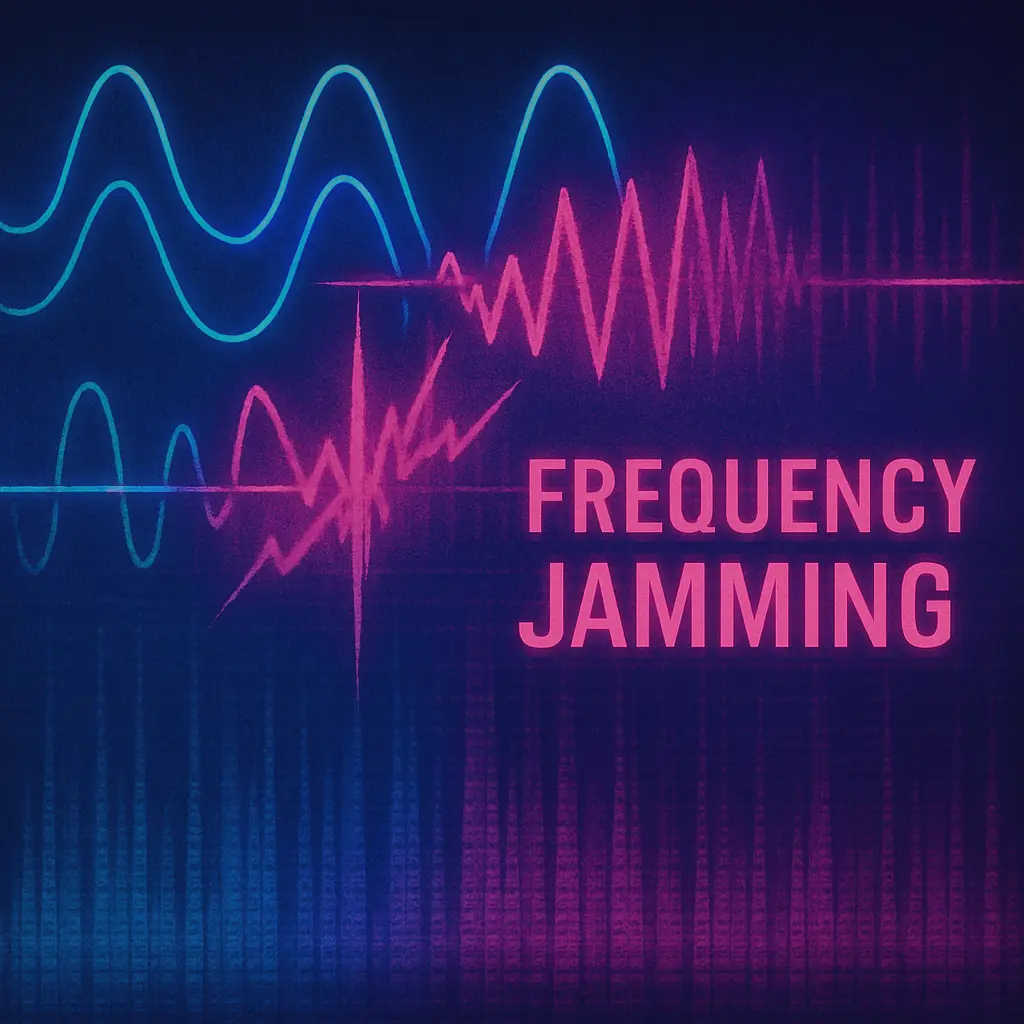
(image) Figure: A simplified illustration of a clean radio signal (top) versus the same signal overwhelmed by jamming noise (bottom). In the clean signal, a periodic waveform is clearly discernible. When a jammer injects noise on the frequency, the intended waveform gets buried in random fluctuations, making it impossible for a receiver to decode the original message. This demonstrates how a strong interference can “override” a legitimate signal (Jamming | Radio Frequency, Signal Interference & Jamming | Britannica) – the receiver hears the loud static instead of the information.
In practice, jammers can be as simple as a broadband noise transmitter or as complex as a system that listens and then mimics/modifies the target signal. For example, a rogue transmitter blasting random noise across a Wi-Fi channel will prevent any orderly Wi-Fi communication. The key point is that radio channels have limited capacity for signal power; a jammer takes advantage by filling that capacity with meaningless energy, leaving no room for the real communication to get through.
Major Frequency Bands Targeted by Jammers
Jammers can be built to target nearly any radio frequency, but in practice certain bands are most commonly attacked due to their widespread use:
- 1.5–1.6 GHz (L-band GNSS frequencies): This includes the GPS L1 frequency (~1575 MHz) used by civilian GPS receivers, as well as similar frequencies for other navigation satellite systems (GLONASS, Galileo, etc.). These signals from satellites are very weak by the time they reach Earth, so even a modest jammer on this band can easily disrupt GPS reception (Jamming and Radio Interference: Understanding the Impact).
- 2.4 GHz (ISM band): A very popular unlicensed band used by Wi-Fi (802.11b/g/n), Bluetooth, and many cordless phones and gadgets. It’s also used for remote control of many hobby drones and RC toys. Jamming devices often target 2.4 GHz to knock out Wi-Fi networks or disconnect Bluetooth accessories by flooding the band with noise.
- 5.8 GHz (ISM band): Another unlicensed band used by modern Wi-Fi (802.11a/ac/ax on 5 GHz channels), and extensively by drone FPV (first-person view) video links. Disrupting 5.8 GHz can cut off a drone pilot’s video feed or jam a Wi-Fi network on those upper channels.
- 433 MHz / 868 MHz / 915 MHz: These sub-GHz bands are used by various devices. In Europe, 433 MHz is common for car key fobs and some IoT sensors, while 868 MHz is used for short-range devices; in North America, 915 MHz is an ISM band used by things like LoRa wireless and some drone control links. Some DIY and long-range drones use 433 or 915 MHz control links for better range (The Issues with Jamming Drone Frequencies | D-Fend Solutions) (The Issues with Jamming Drone Frequencies | D-Fend Solutions). Jamming these frequencies can disable those control systems, but also can interfere with garage openers, alarm sensors, and amateur radio users on the same bands (The Issues with Jamming Drone Frequencies | D-Fend Solutions).
- Cellular Bands (~800 MHz – 2 GHz): Mobile phone networks (GSM, 3G, 4G LTE) operate on various licensed bands (e.g. ~850 MHz, 900 MHz, 1800 MHz, 1900 MHz, 2100 MHz). Illegal cell-phone jammers target these bands to prevent nearby phones from sending or receiving calls and texts. For instance, cheap handheld jammers sold online can knock out mobile signals in a radius of a few meters up to tens of meters (Jamming and Radio Interference: Understanding the Impact) (Jamming and Radio Interference: Understanding the Impact).
- Radar and Military Bands: Radar systems operate at many frequencies (e.g. C-band ~4–8 GHz for weather radar, X-band ~8–12 GHz for many military and marine radars, etc.). Military jammers are designed to target specific radar frequencies or communications bands used by adversaries (including VHF/UHF military radios). These are more specialized and are a core part of Electronic Warfare systems (discussed later). Jamming a radar typically involves either blasting noise at its frequency to blind it or sending false echoes to confuse it (Radar jamming and deception - Wikipedia) (Radar jamming and deception - Wikipedia).
To summarize the above, the table below compares some common frequency bands and how jammers typically attack them:
| Frequency Band | Common Uses | Typical Jamming Method & Effects |
|---|---|---|
| GPS L1 (~1.575 GHz) | GNSS navigation (GPS, Galileo, etc.) | Broadcast noise or chirping signals across the GPS band, overpowering the faint satellite signals (Jamming and Radio Interference: Understanding the Impact). Causes loss of position fix and navigation failure in GPS-dependent devices. |
| 2.4 GHz ISM | Wi-Fi (802.11b/g/n), Bluetooth, consumer drone control | Flood the band with broad spectrum noise or continuous waves ([Wi-Fi jamming attacks: How they affect your smart home security |
| 5.8 GHz ISM | Wi-Fi (802.11a/ac), Drone video links | Similar noise flooding or targeted carrier wave on control/video channels. Results in Wi-Fi network outages and “snow” or freeze in drone video feeds (pilot can’t see). |
| 433 MHz / 868 MHz / 915 MHz | Car key fobs, alarm sensors (433 MHz); Industrial/IoT devices (868 MHz EU); Long-range RC control, LoRa networks (868/915 MHz) | Strong noise or tone on the band. E.g. jamming 433 MHz can prevent car remote locking/unlocking (Jamming and Radio Interference: Understanding the Impact). Jamming 915 MHz can disrupt hobbyist drone controllers or sensor networks, causing loss of control or data. |
| Cellular (e.g. 900 MHz, 1800 MHz, 2100 MHz) | Mobile phone networks (2G/3G/4G) | Transmit interference on uplink or downlink frequencies. Phones show “no service” as they can’t connect to towers. Often used illicitly to silence phones in exam halls, theaters, or by thieves (also used legally in prisons/jails under controlled conditions) (Jamming and Radio Interference: Understanding the Impact). |
| Radar Bands (e.g. X-band ~10 GHz) | Radar systems (military, weather, air defense) | High-power noise or tailored false-return signals beamed at the radar. Noise jamming blinds the radar (no targets seen), while deceptive jamming can create phantom objects or hide real ones (Radar jamming and deception - Wikipedia) (Radar jamming and deception - Wikipedia). Used by military ECM aircraft or ground units. |
How Jamming Impacts Civilian Technologies
Wi-Fi and Bluetooth: These operate in the 2.4 GHz ISM band (and Wi-Fi also in 5 GHz). A jammer in the vicinity can emit signals that “match the Wi-Fi radio spectrum” and thereby drown out legitimate Wi-Fi communications across the entire channel (Wi-Fi jamming attacks: How they affect your smart home security | TechHive). Devices will experience extremely slow connections or complete loss of Wi-Fi connectivity. For example, a Wi-Fi security camera under attack might appear offline, and your laptop might disconnect from the router. Bluetooth devices (like wireless headphones or keyboards) can also malfunction or stutter if the 2.4 GHz band is swamped by a jammer, since Bluetooth hops across the same frequencies. A notable real-world example is the rise in Wi-Fi jamming during burglaries: criminals have used cheap jamming gadgets (even as low as $5 online) to disable home security systems that rely on Wi-Fi sensors (Wi-Fi jamming attacks: How they affect your smart home security | TechHive) (Wi-Fi jamming attacks: How they affect your smart home security | TechHive). In 2024, the Los Angeles Police Department issued warnings after a series of break-ins where thieves jammed homeowners’ Wi-Fi-based alarms and cameras (Wi-Fi jamming attacks: How they affect your smart home security | TechHive). Once the alarm is jammed (unable to send alerts), the intruders can slip in undetected. The clear consequence for Wi-Fi/Bluetooth jamming is a denial of service – cameras can’t send video, alarms can’t trigger, and users lose internet or device connectivity.